Brief
The new Fife College management team wish to develop a prototype for a social media application to support students studying with the new college.They see it as either a native application running on Android OS or a web app optimized for a smart phone. Part of your research should include a comparison between the two platforms along with recommendations about implementation.
The app will cover elements of the Student experience described in the system map that accompanies this brief .It is also seen as an important marketing tool to support the development of the new college brand.
I am to design a prototype for an app for Android or a web app, to be able to be used by a smart phone. The app is to cover the student experience, so include things such as equipment needed and maps of the campuses etc. I am to look at 2 platforms for android/smart phone to see which one works the best.
it is a tool to help promote the college and support the development of the new college.
Research Mobile devices
Background and History:
"The mobile phone was launched in the UK in 1985,for the UK, the first mobile phone networks were provided by Vodafone and Cellnet, both of which launched in January 1985." [1]
"The first ever text message was sent on December 3 1992." In 2012, "According to Ofcom the average person in the UK now sends 50 text messages every week. [2]
The first mobile phone call was made on April 3 1973. "In 2012 a report carried out by the International Telecommunication Union found that there were six billion mobile phone subscriptions worldwide." [3]
The first mobile was released in 19 73. [4]
calls fist cost roughly 15 pence per minute now a days it costs much less and people often preferring to go to contracts than to pay as you go. [5]
Since the first mobile has been release mobile phones are used more for texting,phoning,playing games and accessing the internet. Phones have also become smaller and more affordable with different networks offering different contracts at different competitive prices As shown by the reports show there is six billion phone subscriptions and now on an average 50 test per week where as back when they were first released it was expensive to send a text and make a phone call.
[4] http://uk.ask.com/question/when-was-the-first-mobile-phone-released
[5]http://www.tomshardware.co.uk/forum/43908-38-1980s-cell-phones-costly-minutes
[5]http://www.tomshardware.co.uk/forum/43908-38-1980s-cell-phones-costly-minutes
How Cells Work:
"A basic mobile phone is therefore a little more than a combined radio transmitter and a radio receiver, quite similar to a walkie - talkie or CB radio
In order to remain portable, mobile phones need to have relatively compact antennas and use a small amount of power. This means that mobile phones can send a signal over only a very short range, just like a walkie-talkie.The cellular network, however, enables you to spread the latest gossip regardless of how far away your friends are. This is done by dividing up land into a patchwork of ‘cells’ – hexagonal areas of land each equipped with their own phone mast (also called a base station).These huge phone masts pick up the weak signal from your phone and relay it onwards to another phone mast nearer to your friend. And if you’re on the move while you talk, your phone switches masts as you go without interrupting your call." [1]
 [2]
[2]How GPS Works:
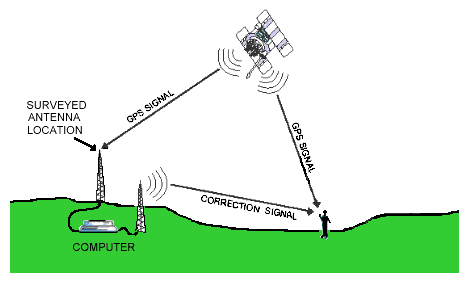
"The GPS satellites transmit signals to a GPS receivers passively receive satellite signals; they do not transmit and require an unobstructed view of the sky, so they can only be used effectively outdoors.[3]
The GPS on a phone can be used to find where you are or help you reach a destination you
are going to.
The GPS on a phone can be used to find where you are or help you reach a destination you
are going to.
 [4]
[4]
[2] http://soni2006.hubpages.com/hub/benefits-of-mobile-phones-how-cell-phones-work-where-to-buy-them
Hardware/Software:
operation LCD screen display diagram
 [1]
[1]
The Displays on phones have been getting more advanced from the black and white pixelated screen to a screen that is touch sensitive, sharp pictured screen.
As well as the screens advancing so has the sizes of the phones meaning the sizes of the screens for example, the Samsung Galaxy Y S5360, the size of the phone is "104 x 58 x 11.5 mm (4.09 x 2.28 x 0.45 in)" and the screen size being "240 x 320 pixels, 3.0 inches (~133 ppi pixel density)" the type of screen the Galaxy Y has is "TFT capacitive touchscreen, 256K colors".this phone has a camera, radio,can access the internet, play music, record videos and much more [3]
The Original Motorola DynaTAc 8000X considered to be the first practical mobile phone was " 300 x 44 x89" in size and only had an LED screen. This phone was uses solely for phone calls as it does not have the gadgets or such things as modern day phones have.[5]
From this we can see mobiles phones getting smaller but more interactive such things as voice command, access to the internet, apps for games and other things show that modern mobiles still with the ability to call and text are becoming more than just a phone capable of calls and texts.
[2] http://www.caseyresearch.com/cdd/advances-display-technology-are-way
[3]http://www.gsmarena.com/samsung_galaxy_y_s5360-4117.php
[3]http://www.gsmarena.com/samsung_galaxy_y_s5360-4117.php
[4]http://natarajank.com/2013/02/10/samsung-a-success-story-worth-reading/
[5] http://esmobil.org/motorola/motorola-dynatac-8000x
[5] http://esmobil.org/motorola/motorola-dynatac-8000x
Cellular network
"A cellular network consists of mobile units linked via a radio network to an infrastructure of switching equipment interconnecting the different parts of the system and allowing access to the normal (fixed) Public Switched Telephone Network." [1]
Definition:
"A cellular network is a radio network distributed over land through cells where each cell includes a fixed location transceiver known as base station. These cells together provide radio coverage over larger geographical areas. User equipment (UE), such as mobile phones, is therefore able to communicate even if the equipment is moving through cells during transmission.Cellular networks give subscribers advanced features over alternative solutions, including increased capacity, small battery power usage, a larger geographical coverage area and reduced interference from other signals. Popular cellular technologies include the Global System for Mobile Communication, general packet radio service, 3GSM and code division multiple access." [2] [3]
[3][1] http://www.doc.ic.ac.uk/~nd/surprise_96/journal/vol4/fjf/report.html
[2] http://www.techopedia.com/definition/24962/cellular-network
[3]http://www2.warwick.ac.uk/fac/sci/eng/staff/wg/teaching/es96t/

No comments:
Post a Comment